On a Monday night, with the weather displaying the traits of between Storm Austen and Storm Boelo, both Irish names in origin, journeys to Emirates Old Trafford for the second speaker evening of the programme proved difficult and hazardous. Add to that the fact that engineering works were being carried out on the Altrincham, Eccles and Media City lines, the three most dreaded words in the English Language appeared on Metrolink information: ‘Bus Replacement Service‘.
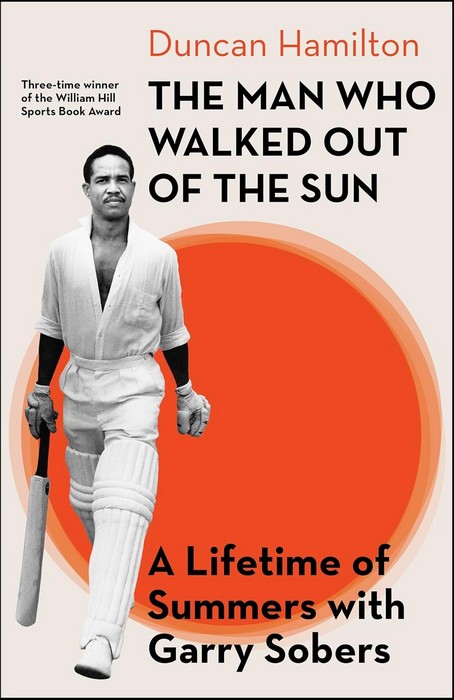
Nevertheless, the doughty people of Lancashire turned out in good numbers to hear author and writer Duncan Hamilton being interviewed by Malcolm Lorimer.
Duncan is the author of several books on cricket persona; most notably Garry Sobers. He is a three-time winner of the Sports Book of the Year. He has written about Jonny Bairstow, Brian Close, Harold Larwood, Brian Clough, Eric Lidell, George Best, as well as fictional novels. He is a giant in the written word of sportsmen of almost every generation and contributes to Wisden Cricketers Almanack and The Cricketer as well as other cricket periodicals on a regular basis.
It was only natural that the first question was about the great Garry Sobers. Duncan never met him but wished he had. In fact, as a Nottinghamshire lad and cricket supporter he has a lot to thank Lancashire for. Because it was Lancashire who would not accept his terms (believed to lie in the fact that they wouldn’t pay off his gambling debts) and therefore he joined Nottinghamshire.
Notts were a poor side when Sobers joined them. He was reputedly paid £5000 a year; the pubs and bookies in and around Nottingham were rubbing their hands in glee as they knew most of that money was coming their way. But Sobers loved the county of Lancashire – he played for Littleborough and Radcliffe, Colne, Church and Todmorden. He liked the pitches. On one occasion he toured with Yorkshire in a tournament in Bermuda. Brian Close was impressed with him and begged Yorkshire to sign him. Bear in mind this was when people born outside Yorkshire were not permitted to play for the county, hence husbands flying their pregnant wives to the county so that their offspring could be born in the county, allegedly. The Yorkshire board asked why the best all-rounder in the world should play for Yorkshire-he’s not a Yorkie!
Sobers enjoyed drinking and gambling and often turned up late for practice and matches. But his life changed after a car accident in which he was the driver. Collis Smith was his passenger and they set off for a match about two o’clock in the morning, not a wise move. Collis crept into the back seat for a nap and at one corner Sobers lost control and hit a large lorry on a bend. Collis was thrown out of the car and later died. Garry said he was afraid of going to sleep after that because of the nightmares he would suffer. There is no doubt that Smith was in line to captain the West Indies to succeed Frank Worrall. On the boat to Australia, Sobers did not sleep because he remembered how much Collis was looking forward to the tour. Had Collis Smith lived it is highly likely that Sobers would never have captained the West Indies.
Sobers was not a great captain; mainly because he batted most of their innings and was always close to the bat in the field. There was no time left for strategic thinking. On that tour to Australia, he spent most of his time playing golf, a game at which he was adept at playing left or right-handed. He did make a pal of the great Donald Bradman
Inevitably the story of the six sixes emerged. Unusual in those days, but not so now in the shorter form of the game. Malcolm Nash was delighted when Sobers hit the six sixes off his bowling because his name would forever be linked with Sobers because of it. But the truth of the story is that Sobers usually came in at six. He had a bet with Les Ames’ wife that Notts would finish in the top four, with a bottle of champagne as the prize. He had an accumulator on three races at Newcastle, and the third race had yet to be run so he sent someone else in at number 6. When his accumulator came in he went out and batted 7. The scoring rate was slow and if they were to achieve their top four finish they needed to get a move on. He certainly did that. Apparently when Bradman heard of Sobers’ feat, his reply was that they had small boundaries in England. The game was played at Swansea.
One story concerned E. W. Swanton, of whom it was said he was that much of a snob he refused to ride in the same car as his chauffeur! He parked his car where the Larwood and Voce pub stands now and wrote a note which said, “Entertain me Sobers”. The note was passed to a fielder and then to the umpire and then to Garry Sobers. Within the next six deliveries the ball was hit by Sobers onto the roof of Swanton’s car. Sobers later said he didn’t want to hit the windscreen as he wanted Swanton to be able to drive home!
Sobers played his last first-class game at Old Trafford in August 1974 and signed off in style with an unbeaten century.
Several questions after the interval concerned Duncan’s association with Notts Forest, for whom he was the correspondent. He travelled on the players coach after Peter Taylor had left; that would never have happened if he had still been there
He also reckoned that Harold Larwood was let down by Pelham Warner on the bodyline tour. Larwood was cold-shouldered by the establishment for the heavily criticised so-called bodyline bowling and Larwood never forgave them. He emigrated to Australia in later life and was loved by the Australian public.
If Duncan could have been in attendance to watch any match, which one would he choose, was the question from one audience member. He replied there were two that stick out; the first one would have been the Middlesex v Gloucester match of 1947 and the other watching Sobers score his 250 v Rest Of The World in Australia.
Next Monday, (2 November) 1pm
Geoff Wellsteed
Back in 2010 Geoff wrote a book entitled Inns & Outs with the late Anthony Collis who was a member of the Inn Sign Society. It identified the 334 pubs in England and Wales that had a cricket related name or an association with the game on the inn sign. It featured just shy of five hundred photographs of cricketing inn signs with some lineage about each pub.
Fifteen years down the line many have closed and a new audit is justified. This task is now underway and the findings will be published in a new book – Cricket Down The Pub – in the spring of 2027.
Given the obvious shrinkage of the original subject the new book will be expanded, and include other cricket/brewery subjects and its content will look something like this –
-Cricketing pubs & cricket related pub signs
-Cricketing beer pump clips
-Cricket and brewery related beermats
-Cricket and beer related matchboxes
-Cricket and brewery related advertisements
-Cricket related pub furniture and miscellaneous interesting ephemera
Geoff’s previous books include:
Pavilions in Splendour (a book about the history of 133 cricket clubs within Cheshire)
Caldy CC Centenary (2021)
50 years of the Cheshire County Cricket League 1975-2024