To read the latest newsletter from our friends at the Sussex Cricket Society click here>>
CMS Newsletter – October 2026
The latest newsletter from the Cricket Memorabilia Society is available to read online.
2026 AGM
The Lancashire & Cheshire Cricket Society AGM is on Monday 26th October 2026 at 12.15pm in the 1864 suite, Emirates Old Trafford and will be followed by our meeting with guest Duncan Hamilton at 1pm.
Click on each of the following links to view downloadable copies of the Agenda, previous AGM minutes and accounts.
Also, click on the following link to view a downloadable copy of the Proposed amendments to the rules of the Society which indicate the changes envisaged.
We look forward to seeing many of you at the AGM.
Sir Clive Lloyd meeting a big success
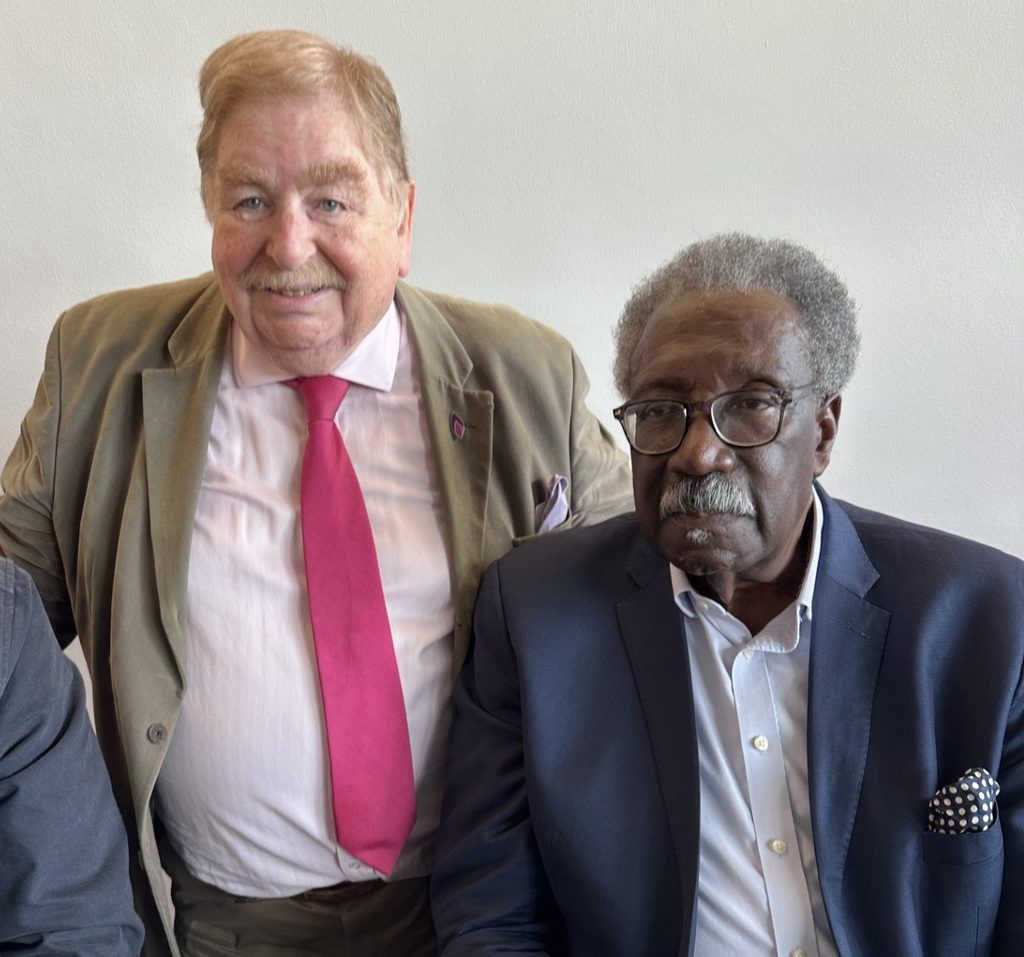
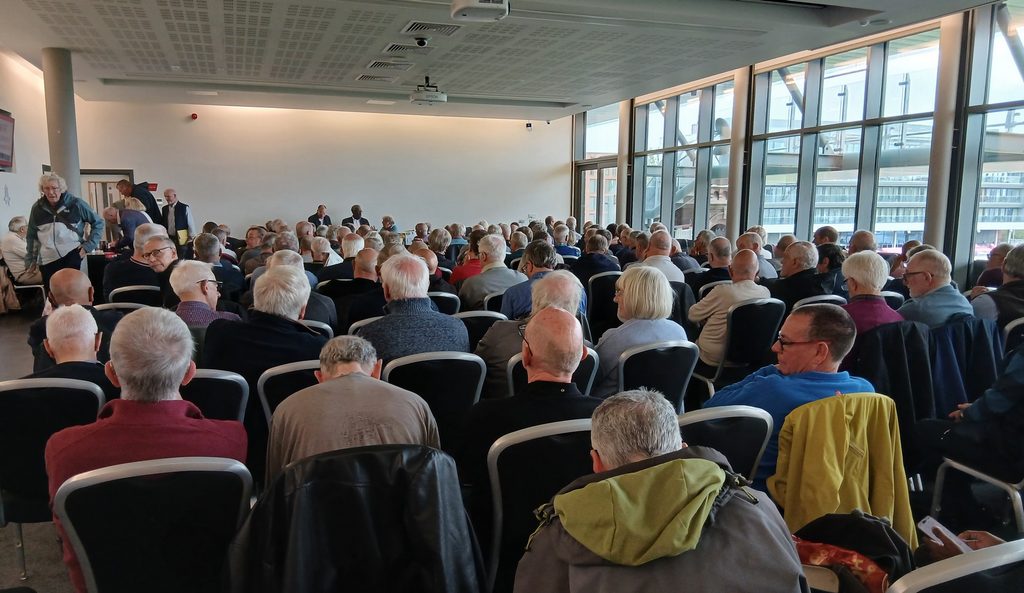
We had a great meeting with Sir Clive Lloyd with over 160 in attendance at Emirates Old Trafford.
Sir Clive spoke movingly about The Great Catch charity which is raising money to combat prostate cancer in the Caribbean, and £1200 was raised on the day with 60 people buying Sir Clive’s recently republished biography ‘Supercat’ .
We have spare signed copies available from Malcolm Lorimer at Max Books and these can be bought online by clicking here.
Sir Clive spoke really well, stating his main aim as Lancashire President was to make sure Lancashire regain their status as a Division One club – where he felt they should be.
There were some hilarious tales about his life at Haslingden County Championship where he was their professional on arrival in England. It was so cold his landlady gave him an electric blanket which he got in trouble over after leaving it on all day and night!
What shone through was his loyalty to Lancashire – a place that had made him so welcome and he never wanted to leave and play for another county.
He spoke warmly about former Lancashire teammates Harry Pilling, Jack Bond and John Sullivan among others.
How a spectator from Yorkshire called the Lancs players ‘dirty b……..sts’. Sullivan asked the spectator to repeat the remark and when he did, the former ABA boxer flattened him with a right hook.
Sir Garry Sobers was his favourite player and running out Geoff Boycott his best bit of fielding.
He was castigated for slow over rates by the West Indies fast bowlers and replied that he could have speeded things up but didn’t want to finish the matches too early!!
New Lancashire Chief Executive Richard Kenyon stopped by on his first day at the club and Dave Taylor introduced him to the audience.
He was given a really warm welcome was given by the members and they were really impressed by him.
Early days, but it looks and feels Lancashire have chosen well.
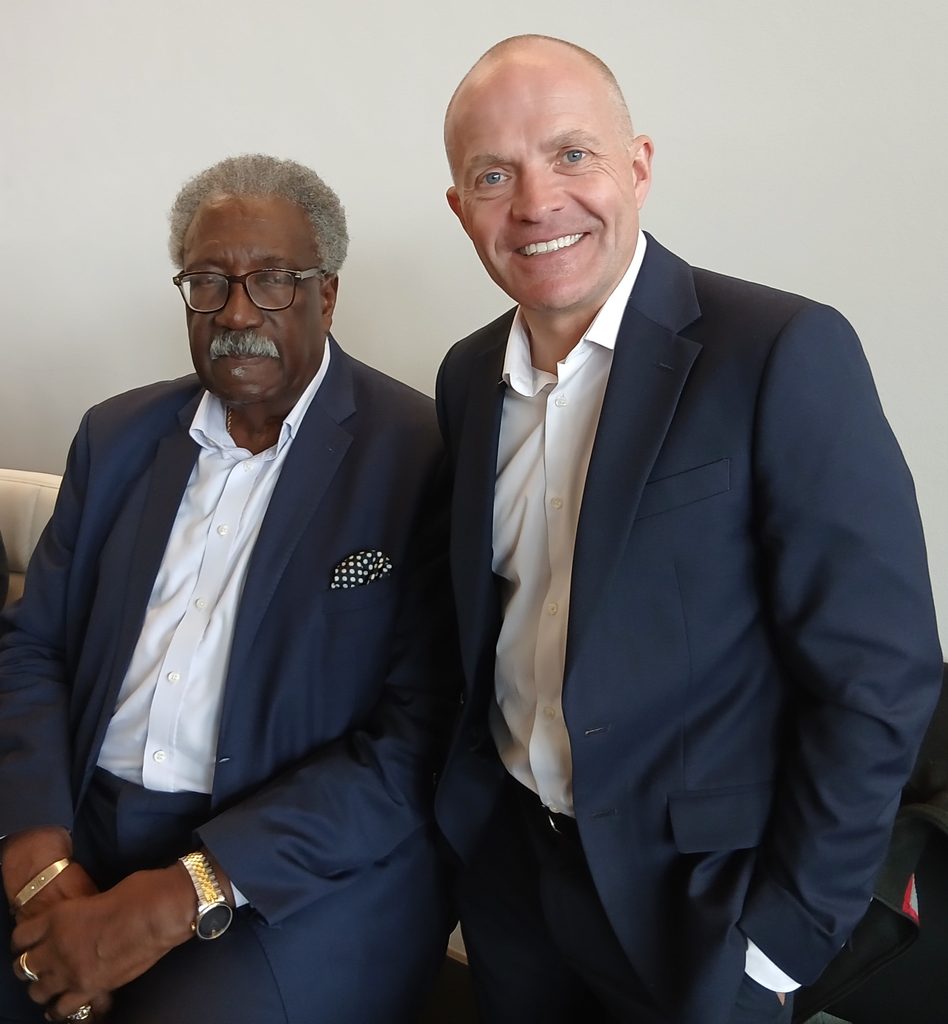
Next meeting: Monday 26th October, 1pm with Duncan Hamilton who will be talking about his latest book on Sir Garry Sobers. David has also written biographies about Brian Clough and Harold Larwood.
Hampshire Cricket Society Newsletter
Click here to read the latest newsletter from our friends at The Hampshire Cricket Society
How “Fred” Became “Neville”
Click here to read: Cardus Goes to School – and is Reborn – by Bob Hilton
How Fred Became Neville: Cardus Goes To School – and is Reborn
Bob Hilton
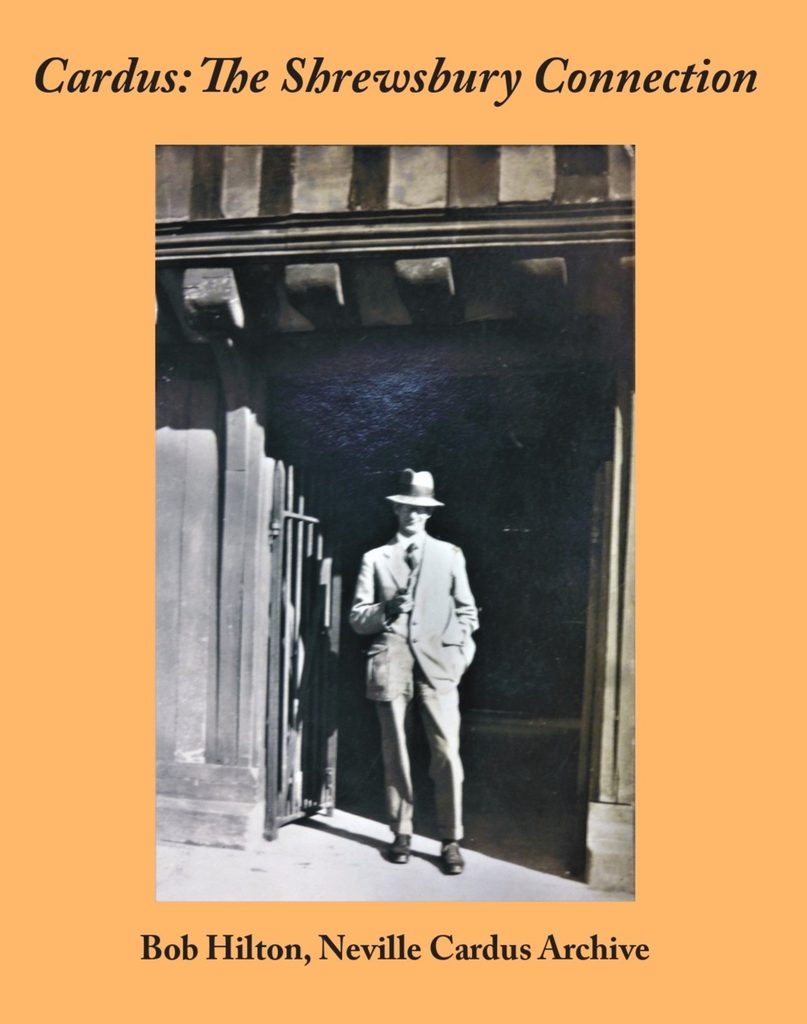
After a sketchy elementary schooling, interrupted by ill-health, Cardus can be found in the January of 1912, working as a lowly clerk in the marine insurance offices of the avuncular brothers Fleming on Bridge Street, Manchester.
Cardus was an original: both shy and assertive, and possessed of an unusual bundle of gifts and skills. He was a useful enough cricketer, although it is not clear that he exercised his talents as a slow-medium off-spinner in any but the junior leagues of Manchester and scratch games. At the same time, he had belatedly conceived a lust for learning, to which end he had set himself to a wide programme of self-education in the humanities, simultaneously steeping himself in the pages of a great regional newspaper, the Manchester Guardian, where he was particularly impressed by two outstanding music critics, Samuel Langford and Ernest Newman. Also available were the resources of Manchester’s municipal libraries and the various free classes and lectures offered by Manchester University and other educational institutions.
Paradoxically, music was not within Cardus’s personal education plan, some singing lessons apart; he felt that music came to him as a special grace. It’s likely that it was not until he became a Guardian journalist himself that he had the chance to steep himself in the grammar of music, when he understudied the great Langford, for several years, as Langford’s successor elect.
All Cardus’s reading was spiced by his participation in a circle of clerking friends who immersed themselves not in politics as such, but in the ferment of ideas prompted by a wave of new orchestral and theatrical productions. It was at one of these events, in the little theatre within Manchester’s newly opened Midland Hotel, that Cardus was first stirred to an intense need and “ache” for music, after hearing the Vilja tune from Lehár’s Merry Widow operetta, around 1905.
To all these eclectic elements, there was added, quite out of the blue, a new factor that bound everything together for Cardus, and switched his life onto an entirely new track. This factor came in the form of an advertisement in Athletic News for an assistant cricket coach, especially one that could bowl, at Shrewsbury School, one of the elite public schools and a far cry from Cardus’s home background.
A modest cricketing accomplishment, an already fluent pen (Cardus practised diligently to acquire a writing style), and a great boldness were easing open the door to a professional writer’s career for Neville, who was still using his baptismal names of “John Frederick” at the time. We can only surmise that he must have written a remarkably eloquent and convincing application form that leapt off the page, playing up his cricketing powers and conferring quasi-professional status on himself without being too specific.
And so, it came about through the power of his pen that Cardus made his unlikely way to Shrewsbury in May 1912 to take up the position of assistant cricket coach at Shrewsbury School, as understudy to Walter Attewell. A dim cricketing figure, Walter is now remembered only as a cousin of the eminent Notts and England medium-pacer, William Attewell, with Cardus apparently under the delusion that it was William himself that he was working under. Cardus always claimed that he had not realised his error, asserting somewhat defensively that, “he [William] was authentic enough in my growing imagination”. Cardus, as the brilliantly imaginative writer he was, later turned the confusion to good account by merging the two Attewells in the character of “Old William”, and featuring him in a number of essays as a fund of homespun wisdom, reliability, and cricket lore; the School itself, lightly fictionalised as “Shastbury”, also figured in a number of Cardus essays.
Cardus’s time at Shrewsbury School opens inauspiciously with an attack of nerves in a trial match. The tremendous realisation is upon him that he now has to make good the extravagant claims made for his cricketing prowess in his application letter – or make an abject return to the grey streets of Manchester. Cardus redeems himself sufficiently to demonstrate a basic competence and to work himself into a comfortable and enjoyable niche, opening up five idyllic and character-building summers for him at the School.
Those golden summers imparted social polish, confidence, and further opportunities to expand his personal “schema of culture” by study in Shrewsbury’s Public Library and also the School Library, access to which was granted to him by the charismatic Headmaster, the Rev Cyril Alington (no mean cricketer himself), who recruited Cardus to perform some secretarial duties for him after the incumbent had been absorbed into the war effort.
And here at Shrewsbury, within the pages of the Shrewsbury Chronicle, “Neville” Cardus was born. “Neville” superseded the diminutive, “Fred”, in a gradual process that began with a short, slight poem he contributed to the Shrewsbury Chronicle (“Fantasy”: Friday, July 18th, 1913). The poem was subscribed, “JF Neville Cardus”, his first known use of his self-adopted name, “Neville” – “Neville” doubtless carrying a writerly dignity that “Fred” lacked. He continued as plain “Fred” for a while in his social and school circles, before emerging in full “Neville Cardus” plumage on November 25th, 1919, as a named Manchester Guardian journalist, here writing of a music hall star’s swan song. He was soon to enjoy the world famous soubriquet, “Cricketer”, as well.
Cardus had become a presence of some quiet standing at Shrewsbury School. His personal needs were few and his income from Shrewsbury kept him through the winter months, allowing him to pursue his private studies and to attend concerts in Manchester. In the winter of 1913-14, he honed his writing and listening skills by submitting elegant but ill-paid concert notices (thirty or so) to the short-lived Daily Citizen newspaper. Walter Attewell was early replaced as cricket professional at School by the authentic Yorkshire Test cricketer, Ted Wainwright, off-spinner and capable bat – to the benefit of School cricket; of Cardus’s own cricketing knowledge and technique; and of Cardus’s fund of writer’s stories, for Wainwright was a rough-hewn but vivid and often bibulous presence.
Cardus’s Shrewsbury idyll came to an end with sickening abruptness, as part of the fall-out from Cyril Alington’s elevation to the headship of Eton. Cardus was plunged from his heaven on earth into a sepulchral underworld in the meanest areas of Manchester, spending several months in casual labour and as a collector of dues for a Burial Society. His plight finally galvanised him into applying directly to the redoubtable editor, CP Scott, for an office job with the Manchester Guardian in any capacity – a fateful step in the New Year of 1917 that led him directly into the august presence of CP Scott himself, and later into the Guardian Reporters’ Room (in which company, Cardus would have been the least formally educated by a very long chalk).
Cardus was finally on his way to fulfilling his destiny, taking his first huge strides into professional journalism and cricketing history.
(Article based on the short book, “Cardus: The Shrewsbury Connection”, Neville Cardus Archive, 2026)
Jim Laker 19 wickets 70th Anniversary Lunch

JIM LAKER -19 WICKETS 70TH ANNIVERSARY LUNCH
Thursday 23rd July, Emirates Old Trafford
It all started with one of Jim Laker’s daughters Fiona e-mailing Emirates Old Trafford and asking what we were doing to remember her father’s great bowling feat 70 years ago in taking 19 wickets in an Ashes Test Match?
Her e-mail was picked up by our new Heritage Manager Alex Cropper and along with Rev. Malcolm Lorimer they set about organising a special lunch in August to remember Jim Laker’s Test world record.
Over 70 people were present at the lunch, including Jim’s two daughters Fiona and Angela and their partners. They brought with them some memorabilia as well as two scrapbooks concerning the match. One contained all the telegrams Jim received from all over the world. There was a special toast to Jim and his two daughters who were rather flattered to have to sign some of menus afterwards.
Alex Cropper brought an original scorebook and a cricket stump from the Lancashire Cricket Collection which had been presented to Rev. David Shepherd, along with other scrapbooks and photos. Neil Robinson, the Heritage and Museum manager from Lord’s, brought the two balls used by Jim Laker in the match.
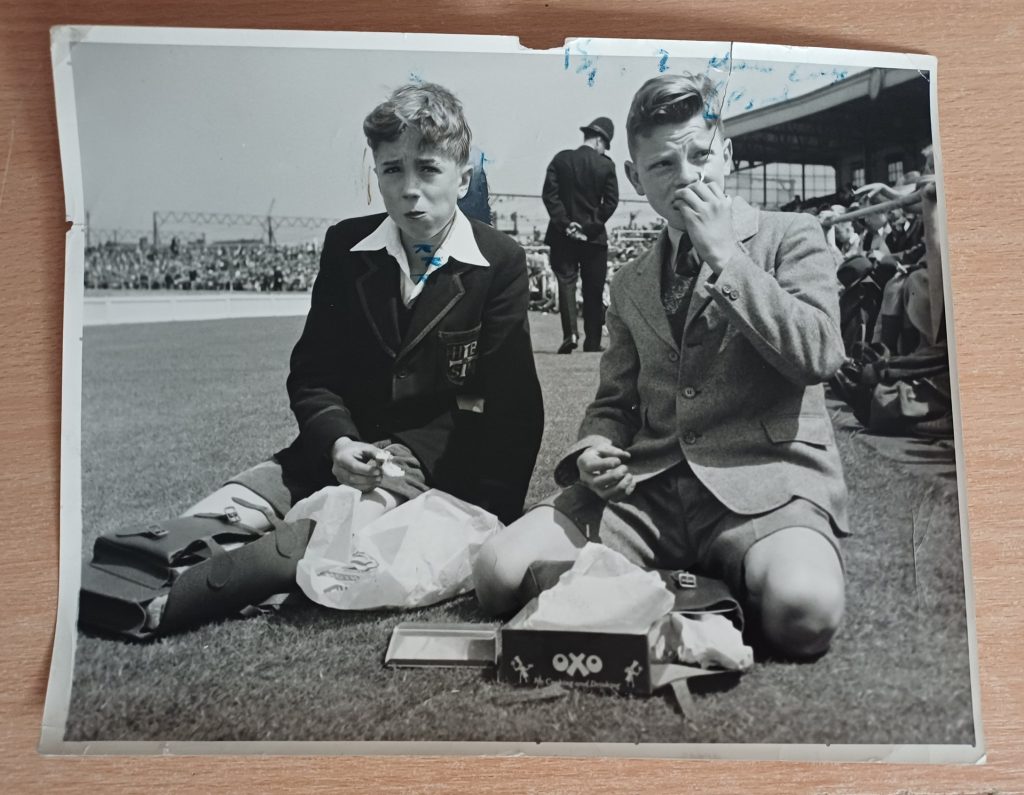
Malcolm Lorimer provided a special menu and a scorecard for each person with an intriguing photo of two young boys sitting on the outfield having their lunch. We are trying to trace these boys from their school badge from Hulme Grammar School.
There was a seventeen-minute film of the Test Match played on the large screen in the room with interviews from some of the players who had played in the match.
Cricket writer Stephen Chalke spoke about Jim Laker, reflecting on the man, the match and its place in cricket history. Also interviews with Fiona, Angela and Patrick – Jim’s grandson – who had played cricket at the Oval and hit two sixes into the Lock & Laker stand!
An excellent three-course meal was enjoyed, everyone spoke highly of the event and one which should be repeated. There is only one problem! – we need another historic match to celebrate.
Rev Malcolm Lorimer
Heritage Team Volunteer
Emirates Old Trafford
Footnote: On the back of the menu there is a photo of two young boys around 12 or 14 enjoying lunch on the outfield. They would be around 70 or 80 now, both we think from Hulme Grammar School. We would like to track them down, do you know who they are?
THANKS TO THE LANCASHIRE AND CHESHIRE SOCIETY FOR HELPING TO SPONSOR THE EVENT

Worcestershire Cricket Society News
We have received the May Newsletter from our friends at the Worcestershire Cricket Society.
To read the newsletter please click on the download button.
Speakers Appreciation
We have received this message from Simon Turner.
I wanted to message you to express my thanks and appreciation for the Society programme of 2025-26.
I really enjoyed the speakers and am aware that a huge amount of work takes place for each one, much of it unseen by the average member.
A friend of mine is a new recruit this season and my brother in law has come twice as a guest and will join next year as a full member.
I wish you well for the new cricket season, as we hope Lancashire are promoted. In addition, I hope you get the speakers you are hoping for in 2026-7.
Thank you again
Simon